
Dementia Care Options After a Stroke

A stroke usually forces families into accelerated decisions about care. It is one of the most common ways a family is pulled into those decisions overnight: more than 795,000 Americans have a stroke each year, and it remains a leading cause of serious long term disability.[1] The hospital does not typically move a parent into a care facility. Most stroke survivors are discharged straight home after their hospital stay, often within days. In one large US study of stroke patients, about 44% went home with no organized services at all.[2] Even patients sick enough to need a rehab or nursing facility afterward spent only about five to seven days in the hospital first.[3] The harder part starts there, because a stroke frequently damages the mind along with the body. More than half of survivors develop some cognitive impairment within the first year, and about a third are at risk of developing dementia within five years.[4] What that adds up to is a parent who is home but not safe, and a family that realizes only weeks later it is facing a level of care no one prepared it for.
The realistic options fall into a handful of categories: care at home, an adult day program, assisted living, a dedicated memory care unit, or a skilled nursing facility. Which one fits depends on two things a stroke tends to damage together: the mind and the body. That double hit is what the American care system is least built to handle, and it shapes every option that follows.

How Does a Stroke Lead to Dementia?
A stroke happens when blood flow to part of the brain is cut off and the tissue there is damaged.[5] When the damage hits the regions that handle memory, judgment, language, or planning, the result can be vascular dementia. It can arrive all at once with one large stroke, or build in steps as a series of small strokes accumulate, each one taking a little more.[5]
The risk is highest right after the stroke. In the first year, a survivor's chance of developing dementia is nearly three times that of someone who never had one.[6] That is part of why this decision differs so sharply from a slow Alzheimer's diagnosis: there is rarely time to plan. The family is often making a long term choice in a hospital hallway, within days.
What Are the Care Options After a Stroke?
The five settings above, in plain terms:
Care at home, provided by family or by paid in-home caregivers who come by the hour or around the clock.
An adult day program, where the person spends daytime hours in a supervised setting and returns home at night.
Assisted living, a residential setting that helps with daily tasks like bathing, dressing, and medication but is not built for significant memory loss.
Memory care, a secured residential setting designed specifically for dementia, with staff trained to handle confusion, wandering, and agitation.
A skilled nursing facility, often called a nursing home, which provides full-time medical and nursing care for people with serious physical needs.
A stroke is one of the few events that can leave a person needing several of these at once: the intensive nursing of a skilled facility for the body, the specialized supervision of a memory care unit for the mind. American facilities are mostly built for one job or the other, which makes the next distinction the one families most need to get right.
What Is the Difference Between Memory Care and a Nursing Home?
Most families leaving the hospital get caught on this one. A skilled nursing facility is organized around the body: wound care, feeding, physical therapy, and managing the paralysis or swallowing trouble (dysphagia) that a stroke often leaves behind. Memory care works on the mind: routine, orientation, and staff who know how to respond when a resident is frightened or no longer recognizes the people around them.
When a stroke causes dementia, a person frequently needs both. The trouble is that choosing one usually means the other gets shortchanged, if it is covered at all. A nursing home may keep someone medically stable while leaving the dementia essentially unmanaged. A memory care unit may handle the confusion well but lack the nursing depth for serious physical deficits. Families are asked to choose which need matters more, when neither one can be safely set aside.
How Do You Pay for Care After a Stroke?
Long-term care is mostly paid out-of-pocket, or covered in part by a few programs:
Medicaid, the joint state and federal program for people with limited income and assets, which is in fact the single largest payer for long term care in the country. More than 60% of nursing facility residents have it as their primary payer, and it does cover ongoing nursing care once a person qualifies, though the application is slow and an open bed can be hard to find.[7]
Veterans benefits, including the Aid and Attendance pension, which can add a meaningful monthly amount toward care for a veteran or a surviving spouse. One thing to know: for most veterans the VA helps fund private care through this pension rather than simply providing a memory care bed, and where the VA does run dedicated beds, through State Veterans Homes, the memory care waitlists run months to years.
Adult foster care and board and care homes, small residences looking after a handful of people in an ordinary house, which often cost less than a large facility and can feel more personal.
These programs help, and they are worth pursuing before anything else. What none of them solves is the core problem here: getting enough trained hands on one person, consistently, to serve the body and the mind together.
Why Is Good Care So Hard to Find After a Stroke?
With the mind and the body both demanding attention, the ratio of caregivers to residents is decisive.
The American system breaks down on staffing. In a typical memory care unit, one aide may be responsible for eight, ten, or more residents at a time, and more overnight. Turnover is staggering: across US nursing homes, total nursing staff turn over at a median rate of about 94% a year, so the familiar faces a person with dementia leans on are replaced almost wholesale within twelve months.[8] The work pays a median of about $17 an hour, and the field is short people by the millions. Close to 10 million direct care jobs will need to be filled between 2024 and 2034 as workers burn out and demand climbs.[9] One person cannot dress, feed, toilet, and reorient a stroke survivor while doing the same for ten others. So the physical and cognitive needs get triaged, the resident is often medicated to be manageable rather than engaged, and the family pays a great deal of money to watch a parent decline faster than necessary.
Why Does the Same Care Cost a Fraction Abroad?
Start with what American care costs. The national median runs around $6,700 a month for memory care[10] and about $10,800 for a private room in a skilled nursing facility,[11] before the extra fees that pile up for anyone with complex needs. A stroke survivor who needs both kinds of care can exceed all of that.
What families are rarely told is that this price has very little to do with the care itself. The American bill is built from costs the resident never sees. The minimum wage sets a caregiver's base pay. Layered on top are the financing on a purpose built building, the regulatory and liability overhead, the referral fees paid to the placement agencies that steered the family in, and the profit that corporate or private equity owners (investment firms that buy up care homes) expect to take out. Each layer is added by an intermediary who adds cost without adding a single hour of care at the bedside.
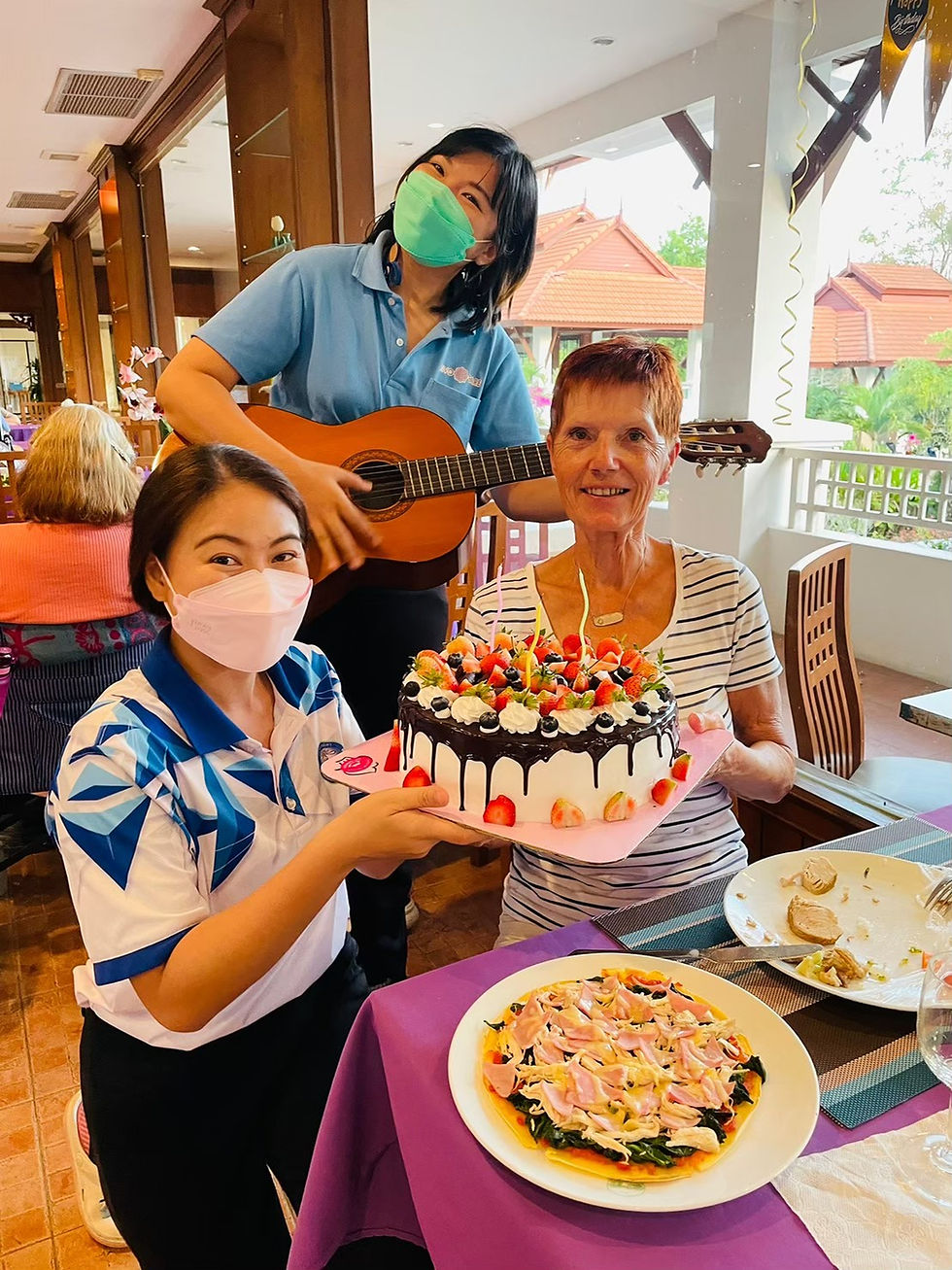
Abroad, several of those layers shrink or disappear, and not by a few percent. The labor cost, the building financing, the regulatory overhead, the referral fees, the corporate profit, even the climate that lets a home stay open to its gardens all year: each one can differ by two to ten times on its own, and they compound. The result is not a discount version of the same thing. It is more care: caregivers paid a genuine living wage in their own economy, often at one caregiver to one resident, for a fraction of the American total. In Thailand, the strongest version of that model, one caregiver per resident through the day and one to three overnight, costs about $3,500 a month with room and meals included, against the $8,200 to $13,000 that American care at one caregiver to twelve costs to deliver. On the measures that actually decide dementia outcomes, the place families assume they are trading down to is the better one.
What Should Families Ask Before Choosing Care?
Whatever option a family weighs, at home or abroad, a few questions cut through the sales pitch; ask each one and listen for the answer in parentheses:
How many residents does one caregiver look after on the day shift and the night shift? (A good answer is a small, specific number that does not balloon after dark. If they dodge or quote only the daytime figure, assume the real ratio is worse.)
How long has the staff worked here, and will my parent see the same caregivers each day? (You want years, not months, and a clear yes on consistency. With industry turnover near 94% a year, a place that keeps its people is telling you something real.)
What training do caregivers have in dementia specifically, beyond general nursing? (The answer should name an actual method of person-centered care and describe what staff do when a resident insists it is a different decade. The right response is some version of letting the person stay in their reality rather than correcting them.)
How will you care for the body and the mind together after a stroke? (A real answer describes both the physical therapy and the cognitive support under one roof, not a referral elsewhere for half of it.)
A stroke forces fast decisions, but the one that matters most is not which facility has an open bed this week. It is which setting can put enough trained, consistent hands on one person to tend the body and the mind at once. That standard is hard to meet in the American system at any price an ordinary family can afford, because the money goes to the building, the owners, and the agencies long before it reaches the bedside. That same standard is met elsewhere, at a fraction of the cost, by people who built their model around the caregiver rather than around the building and the fees. The options after a stroke are wider than a discharge planner has time to tell you, and the first available bed is rarely the only one.
References
Centers for Disease Control and Prevention, Stroke Facts. https://www.cdc.gov/stroke/data-research/facts-stats/index.html
Contemporary Trends and Predictors of Postacute Service Use and Routine Discharge Home After Stroke. Journal of the American Heart Association, 2015. https://pmc.ncbi.nlm.nih.gov/articles/PMC4345857/
Discharge Patterns for Ischemic and Hemorrhagic Stroke Patients Going from Acute Care Hospitals to Inpatient and Skilled Nursing Rehabilitation. https://pmc.ncbi.nlm.nih.gov/articles/PMC6095808/
American Heart Association / American Stroke Association, Cognitive Impairment After Ischemic and Hemorrhagic Stroke (scientific statement, Stroke, 2023). https://newsroom.heart.org/news/cognitive-impairment-after-stroke-is-common-and-early-diagnosis-and-treatment-needed
Alzheimer's Association, Vascular Dementia. https://www.alz.org/alzheimers-dementia/what-is-dementia/types-of-dementia/vascular-dementia
American Heart Association, Dementia Risk May Nearly Triple in the First Year After a Stroke (International Stroke Conference). https://www.heart.org/en/news/2024/02/02/dementia-risk-may-nearly-triple-in-first-year-after-a-stroke
KFF, 5 Key Facts About Nursing Facilities and Medicaid. https://www.kff.org/medicaid/5-key-facts-about-nursing-facilities-and-medicaid/
Gandhi, Yu and Grabowski, High Nursing Staff Turnover in Nursing Homes Offers Important Quality Information. Health Affairs, 2021. https://www.healthaffairs.org/doi/full/10.1377/hlthaff.2020.00957
PHI National, Direct Care Workers in the United States: Key Facts. https://www.phinational.org/policy-research/key-facts-faq/
A Place for Mom, How Much Does Memory Care Cost? https://www.aplaceformom.com/caregiver-resources/articles/cost-of-memory-care
CareScout, 2025 Cost of Care Survey Results. https://www.carescout.com/cost-of-care

